Heartburn in Lecce
A postcard from Puglia

Dear Inga,
On my flight to Puglia last month, I ate some potato salad that I’d made in a tupperware box and then drank a vodka and tonic from a plastic cup. I’d smuggled in a dinky bottle of vodka that came in my Christmas stocking last year. I wondered if this is the exact purpose of making such tiny bottles, they are perfectly travel-sized.
I was thinking about how you travel Inga, moving elegantly from place to place with your pristine and carefully packed suitcase. You are the embodiment of glamour, always immaculate and with a subtle cloud of celebrity around you. I think your sharp blond fringe and big glasses contribute to this.
I remembered the story you told of your most recent flight to England from Sweden earlier this year. You were on a Ryanair flight (for your glamour is not dependent on the price of your ticket) and as soon as you had taken off, you pinged the button and asked, charming and sparkling, for a glass of champagne. The air hostess was so taken aback by your keen request, and suitably charmed by you, that she presented the glass and refused to let you pay. This was Ryanair! Once you’d finished that glass and some open-faced sandwiches you’d brought with you (I imagine rye bread with smoked salmon, dill and lots of black pepper), the man sitting next door asked if you might let him treat you to another glass. This is what I pictured as I ate my potato salad and drank my tepid vodka and tonic. Your glamour has yet to rub off on me it seems.
Sitting next to me on my flight were two North Americans called Simplicity and Simon (yes, really). They’d embarked on a tour of Europe in search of the Divine Feminine. They were looking for it (for her?) in grottos and cathedrals in Ireland and France, and in caves and chapels in Spain and Italy. When they told me this, I nodded knowingly as if I too had considered making this very pilgrimage myself. Simplicity, who for most of the flight was wrapped in caramel cashmere reading Rilke, leapt up in joy when she heard me tell Simon that I grew up near Stone Henge. She scanned me to see if I possessed any Druid magic, and asked ‘do they really do all of those rituals in Salisbury?’ I waited blankly for her to elaborate.
The only rituals I’ve witnessed in Salisbury, the cathedral city where I went to school, involved reciting prayers in Latin and singing psalms in the choir. Occasionally they burn incense during services in the Cathedral in what I have just now found out is called a Thurible (which is swung by a person called a Thurifer). Now we know. I didn’t think that’s the information Simplicity was after though, so I scanned my memories of Salisbury (which mostly involve the Odeon cinema and the big New Look) and tried to insert stills from the Wicker Man over them. I started to share my experiences of joining the masses of Druid and non-Druid revellers to celebrate the Solstice at Stone Henge, but they’d been there and done that (and showed me the selfies to prove it) at various stone circles on their various spiritual missions around Europe. In the end I gave her as vivid a description as I could of the Morris Dancers and Mayday celebrations that I saw once at the local Cuckoo Fair, and hoped it would satisfy her with its pagan whimsy.
The next day by lunchtime I was in Lecce, a walled Baroque city in the south of Puglia built in blocks of creamy limestone. The streets circle around one another within the outer walls encouraging you to get lost and surprised. I want to tell you about what I ate in Lecce- I felt as though it was testing my gluttony, seeing if I was ready for everything Puglia had to feed me. And I think I passed its test.
I’d noticed a spot with tables in the sun and green things in pots as I hauled my suitcase over the cobbles towards my b&b. I went straight back there once I’d offloaded everything and felt exactly 28kg lighter bounding towards the table waiting for me. They had a collection of wine bottles in a bucket on the ground, and a big blackboard with a small menu of locally-foraged things to eat. On the opposite side of this triangular piazza was a bric a brac shop. It had a few brown tables and chairs and speckled mirrors outside which gave it the appearance of a nice bar. The owner was sitting at one of the tables in the sun drinking a bottle of Peroni which added to the illusion. I watched him through the potted lemon tree next to me as I drank a glass of pink-ish wine with a bowl of taralli.
For lunch, I found the orecchiette I’d been waiting for- it had soft garlicky cime di rapa, anchovies, and crunchy pangrattato on top. I read Nora Ephron’s book Heartburn as I ate. Oh what pleasure to heap deep green pasta into my mouth while chuckling at Nora’s wit. At this particular moment in the book, she is seven months pregnant and has just discovered her husband’s affair with a tall woman called Thelma who makes ‘gluey’ puddings. She considers spending the day in the bath and says:
‘nothing like crying in the bathtub for real self-pity, nothing like the moment when every last bit of you is wet, and wiping the tears from your eyes only means making your face even wetter.’
I marvelled at how one minute she’s identifying a universal standard of feeling pathetic, and then on the next page she’s talking about her cheesecake recipe and her mother’s second husband who she refers to as ‘Mel who thought he was God’. She brings you along, nodding in amusement and agreement, all the way through. I felt lucky that I’d held off until this exact moment of my life to read Nora Ephron for the first time, and equally lucky to be reading it in the only country that grows the marvellous green vegetable filling my plate.
That night, after some writing, lots of walking and a photography exhibition that I didn’t realise was aimed at children, I sat on a high stool in a bar with low lighting, and ordered an aperitivo of anchovies to go with my beer. I was picturing maybe 4 fat anchovies lined up on a plate in a shallow bath of olive oil - it’s a recurring motif on London menus in restaurants like Brutto and Brawn. But what came to my table was this: a pat of butter the size of a bar of soap, a brown paper bag of sliced baguette and a tin full of anchovies. A tin full. A whole tin! I was delighted.
I felt slightly conspicuous as I made my way through them; a thick layer of butter on each piece of bread, twirling an anchovy on top, oil on my shining chin. Each mouthful was a punch of salt, then soft sweet butter. Only towards the end did I wonder, is this too many anchovies? How many is too many anchovies? I considered this as I slicked another one into my mouth and licked my fingers. I ate them all. I came here to eat, and I am eating.
At the restaurant I worked in most recently, I ate a lot of anchovies. They were permanently on the menu, marinated on a big plate on the kitchen pass looking pretty. People could order a few to have with their drinks. I loved this job, taking my time to organise them one by one on the plate. I’d crush chilli flakes and fennel seeds, zest a lemon and chop a bunch of dill, then sprinkle it all onto a big flat plate and cover it with olive oil. Then the anchovies would go on one by one like tiles. Then more of the aromatics on top and enough oil to cover it all. The plate would shine with yellow and red and the gold of the oil, and the silver of the fishy mosaic. And as people ordered them I’d arrange about 6 of them abstractly on a little plate.


The following night I sat in a different bar, this one was a long low arch reaching back off the street. The main colours were stone and red, and the dark brown of the counter that ran all the way down along one side with low lamps over it. On the other side were small wooden tables with purposefully mismatched chairs. And at the very end of the room, there was a green armchair just for me.
I ordered a negroni and looked at the menu. The aperitivi snacks were listed under the title Stuzzicando which is an excellent, slinky word. Stuzzicare l’appetito literally means ‘to whet the appetite,’ but stuzzicare on its own suggests provoking, or teasing, or arousing depending on what or who you’re talking about. It is a versatile word that can be used in all sorts of contexts to do with desire and appetite and pleasure. Stuzzicare. It is quite unlike our strange solid English word ‘whet.’ Why is it spelled like that? There is no pleasure at all in ‘whet.’
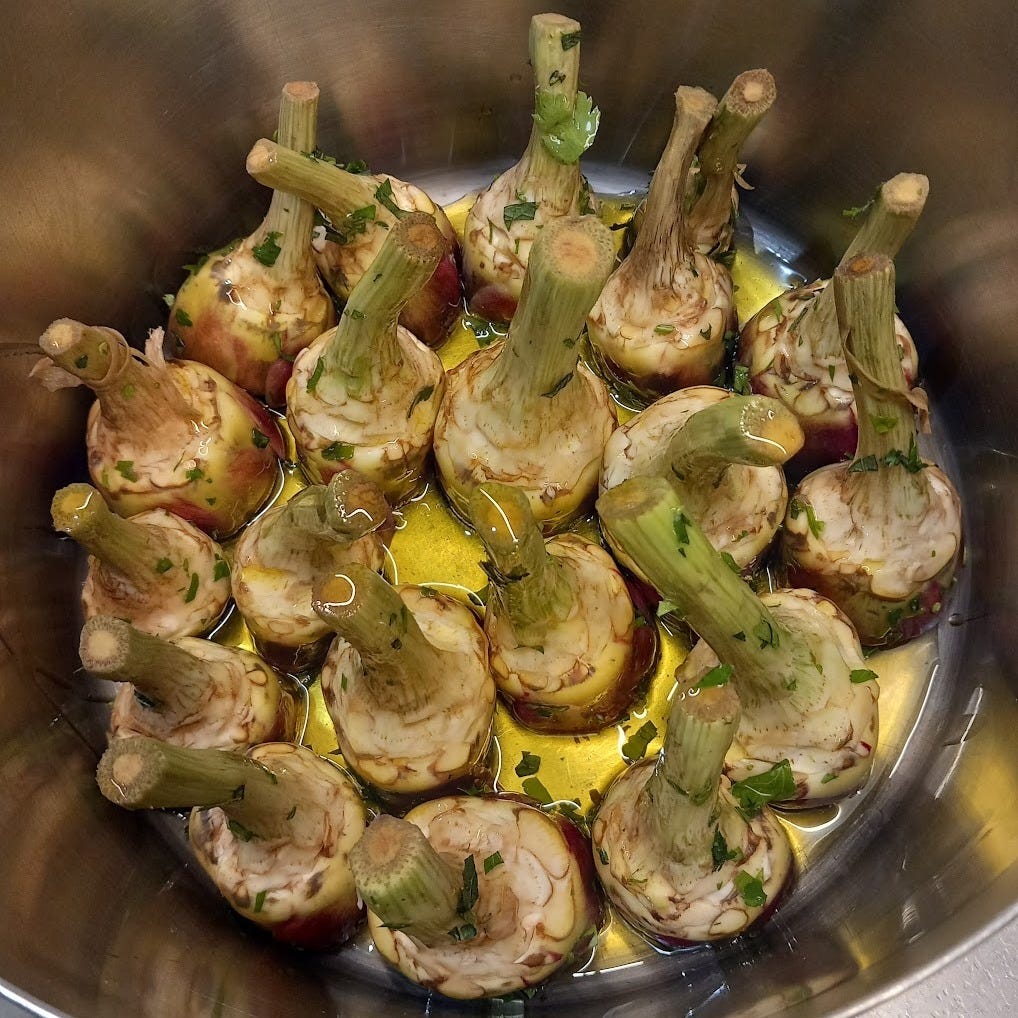
Anyway, this was the sort of bar with a promising window of small savoury things on display - I saw neatly trimmed sandwiches and chunks of cured meats and shapely cheeses ready to be sliced onto wooden boards. On the menu I saw carciofi alla Romana sott’olio / Roman style artichokes in oil. I love eating artichokes cooked in this way, especially when I haven’t had to prepare them myself. Getting artichokes ready to eat is one of the most tiresome jobs in the kitchen. They stain your hands a yellow brown that lasts all week, they’re tough and they’re spiky, and there are so many steps.
There’s peeling the stalks down to the soft marrow but not too far, trimming the outer leaves off in a deft circular move, and slicing the thorny tops off of the remaining leaves (this part will blunten your most useful knife and give it a brown stain to match your fingers). You then use a melon baller (of which there is usually only one in the whole kitchen, location undetermined) to scoop out the furry inside of the choke. And after all that, you make a mix of chopped parsley, mint, lemon zest and garlic and push it into the hole left in the middle, trying to get it between the leaves as much as possible too. You then fry them standing up in a big pan, and then add wine and more herbs and lemon zest and steam them until they’re just soft. You can store them in oil to preserve them as this place had done.
But after all that work they couldn’t be anything but delicious. They are herby from all those herbs you chopped, but also from the artichoke itself. Artichokes have a flavour which, now that I’m trying, is quite hard to describe: herbaceous? grassy? A bit like a creamy green olive? Words don’t seem to be helping. I’ll move on. This traditional method of preparing them is called alla Romana (Roman style) and is one of the most popular Italian recipes for artichokes. There’s also carciofi alla Giudea (Jewish style) where they are deep fried and they open up like beautiful crispy sunflowers.
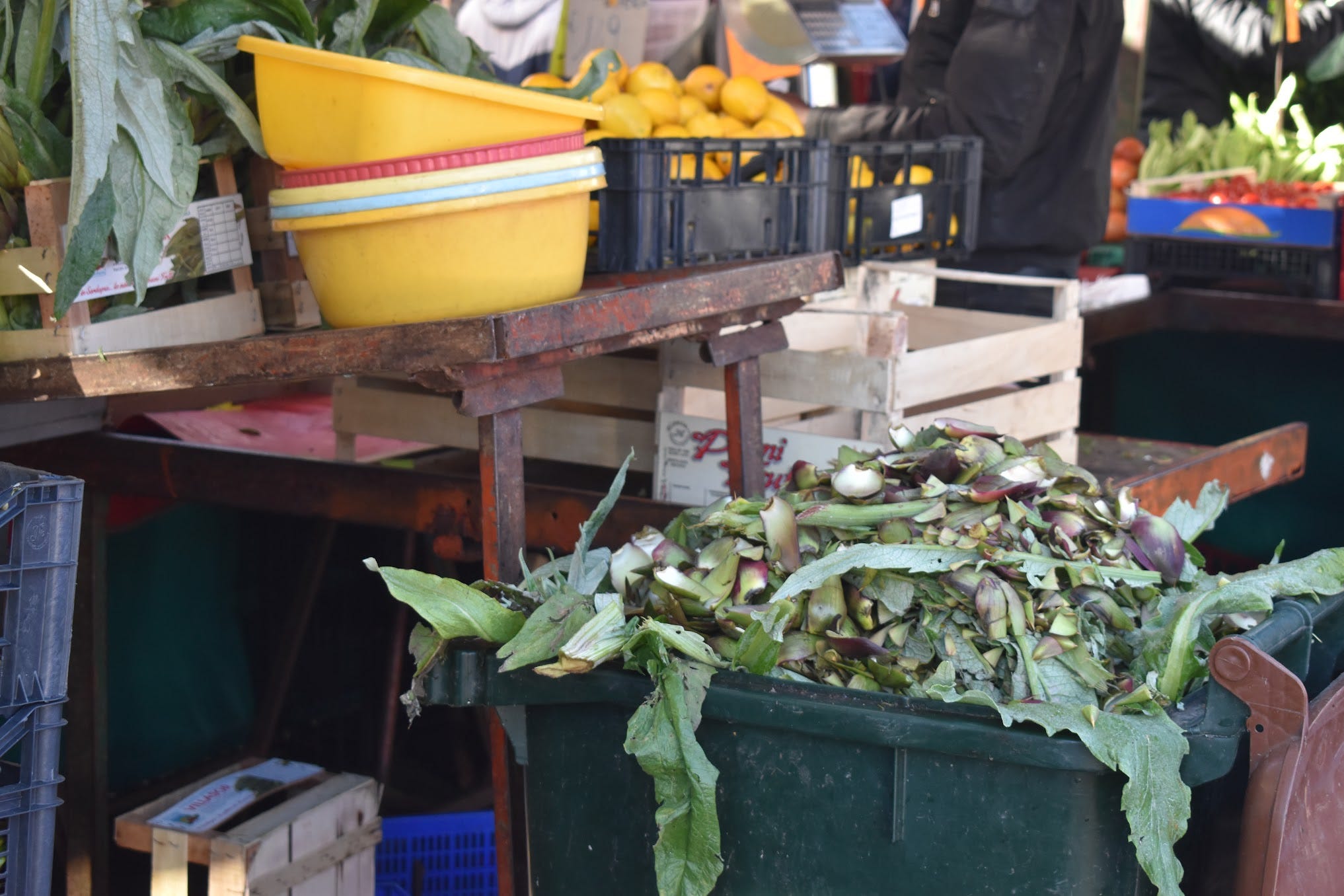
Artichokes are remarkably available to buy in Italy, in markets and supermarkets, which must mean that people do buy them and prepare them at home. Often stallholders at the market will spend the morning trimming them down, leaving a pile of leaves around their feet and making it all look much easier than I’ve just described.
So these two perfectly prepared artichokes arrived with my negroni and I was happy. I thought about how clean my hands looked, how my wrists were free from repetitive strain etc. There was no cutlery, and instead of standing up and getting some, I thought about how artichokes, if these ones weren’t so very oil slicken, are the perfect handheld food. There are the leaves to pick off one by one, and then the centre left on the stalk becomes a sort of lollipop shape. The only problem was Nora Ephron. I’d been engrossed since yesterday, the book was in one hand and I was not ready to put it down; someone called Betty had just unknowingly tried to invite Nora to lunch with Thelma, the tall woman who is having the affair with her husband.
So I used my other hand to alternate between sips of negroni and plucking off a few artichoke leaves. My negroni was now a bit slippy, but I continued undeterred. It took some dexterity but I manage to pick off all the briny herby leaves, doing little dances of satisfaction after each bit. Eventually, book still in hand (Nora is trying to crawl out of this dinner, but somehow it has expanded into a dance event) and negroni not on the floor, I got to the heart on its perfect stalk and I triumphantly ate it like a Cornetto.